Wiring in mass storage battery modules presents a critical challenge in modern energy storage systems, particularly for industrial air-cooled, liquid-cooled, and residential battery packs. Traditional wiring harnesses create dense, tangled cabling networks, increasing assembly complexity, production errors, and maintenance difficulty. Manual connections for hundreds or thousands of cells not only consume significant labor time but also raise the risk of electrical shorts, contact failures, and uneven thermal distribution.
Sun.King Technology’s Cells Contact System (CCS) architecture addresses these challenges by integrating high-voltage cell connections, real-time voltage and temperature monitoring, and built-in protective mechanisms into a compact, automated framework. By drastically reducing the number of discrete wires, simplifying series and parallel cell interconnections, and enabling precise data collection for each individual cell, CCS streamlines module assembly while enhancing system safety, thermal management, and operational reliability. This innovation is particularly crucial for mass storage energy systems, where performance consistency, maintenance efficiency, and downtime reduction directly impact operational cost and long-term ROI.
Streamlining Connections with Integrated CCS Architecture
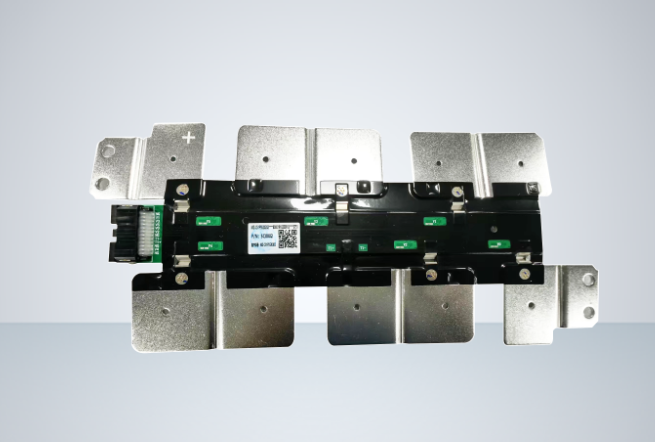
The Sun.King CCS enables manufacturers to replace complex wiring harnesses with a unified contacting system that consolidates power transmission and signal collection into a single modular structure. Key benefits include:
Reduction of assembly steps: fewer manual connections mean shorter production cycles and reduced error rates.
Minimized potential failure points: each manual connection eliminated decreases the likelihood of shorts or poor contacts.
Compact module design: integrated pathways reduce spatial requirements, supporting higher energy density modules without wiring clutter.
This integration is especially valuable for air-cooled and liquid-cooled mass storage modules, where thermal management and compact design are critical for both performance stability and longevity.
Enhancing Monitoring, Safety, and Operational Control
Sun.King CCS incorporates voltage and temperature sensing directly at each cell, enabling automated data collection without extensive point-to-point wiring. The system provides:
Real-time thermal mapping: early detection of hotspots prevents thermal runaway and prolongs cell life.
Voltage balancing and monitoring: each cell’s operational data supports precise series-parallel load management.
Built-in protection mechanisms: overcurrent, short-circuit, and contact failure protection are integrated, minimizing reliance on external fuses or monitoring boards.
Studies in high-capacity energy storage systems indicate that integrated monitoring architectures can reduce module failure rates by over 20%, especially in systems exceeding several kilowatt-hours.
Supporting Automation and High-Volume Production
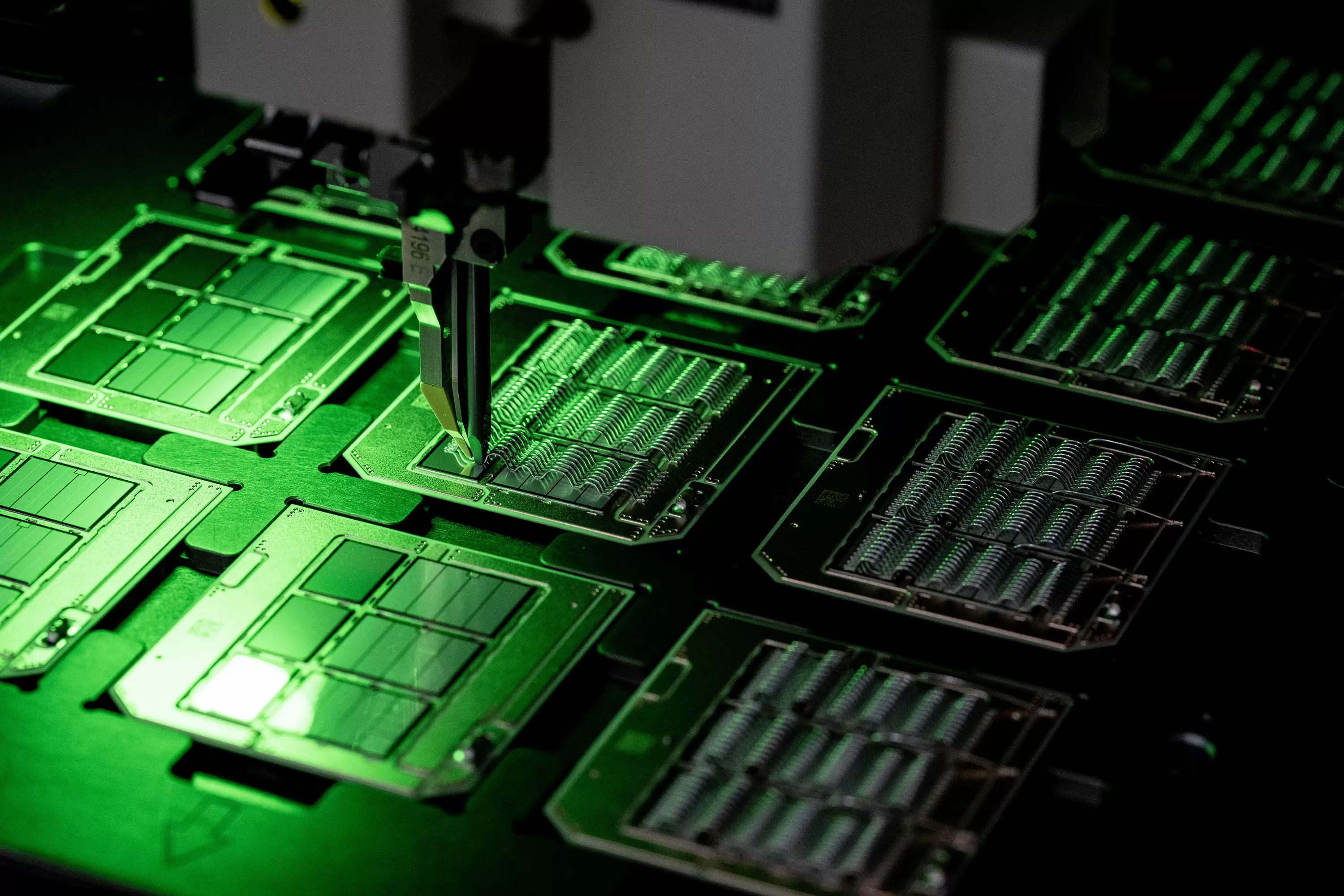
Manual wiring is labor-intensive and prone to errors, particularly in high-capacity mass storage modules. The Sun.King CCS supports automated module assembly, resulting in:
Faster production cycles: fewer manual connections shorten assembly time.
Improved repeatability: automated placement ensures uniform contact pressure across all cells.
Inline quality control: real-time voltage and temperature sensing reduces the need for manual inspections.
Automation reduces human error, the primary cause of connection failures in industrial energy storage modules, improving both assembly quality and operational reliability.
Thermal Management and Efficiency Benefits
By consolidating wiring paths and reducing contact resistance, CCS contributes to lower heat generation at connection points:
Improved energy efficiency: less power is lost as heat at cell interconnections.
Enhanced cooling system performance: both air-cooled and liquid-cooled modules benefit from reduced localized heating.
Extended module lifespan: stable thermal performance reduces mechanical stress and material fatigue.
These improvements are critical for maintaining the performance and reliability of mass storage energy modules operating in demanding industrial environments.
Lightweight, Compact, and Scalable Design
Sun.King CCS’s modular design replaces bulky multi-cable harnesses with standardized contact plates and busbars, delivering:
Higher energy density per module: less wiring allows tighter cell packing.
Simplified maintenance: standardized components are easier to inspect and replace.
Scalable architecture: adaptable to residential, commercial, and industrial energy storage applications.
This flexibility enables system designers to optimize module layout without compromising safety or performance.
Reliability, Maintenance, and Operational Advantages
Reducing wiring complexity directly improves module reliability:
Fewer manual connections lower the likelihood of shorts and contact failures.
Integrated voltage and temperature monitoring supports predictive maintenance, reducing unplanned downtime.
Standardized modules simplify repairs, enabling rapid replacement of faulty components without extensive rewiring.
Operators gain more predictable maintenance cycles, safer energy storage deployment, and enhanced long-term ROI.
Frequently Asked Questions (FAQ)
Q1: How does CCS reduce wiring complexity in mass storage battery modules?
CCS integrates cell connections, voltage, and temperature monitoring into a single modular system, eliminating most manual point-to-point wiring.
Q2: Can CCS improve module thermal performance?
Yes, low-resistance contacts and reduced wiring clutter lower heat generation, improving both air- and liquid-cooled module efficiency.
Q3: Is CCS compatible with automated production lines?
Absolutely. The modular design supports automated assembly, inspection, and inline testing, significantly shortening production cycles.
Q4: Can CCS scale to different types of energy storage systems?
Yes, from residential battery packs to industrial-scale modules, CCS supports modular and scalable deployment.
Conclusion: Building Smarter, Safer, and More Efficient Energy Modules
The Sun.King cell contacting system architecture represents a transformative solution for mass storage battery module assembly and operation. By eliminating wiring complexity, integrating real-time voltage and thermal monitoring, and supporting automated high-volume production, CCS enables:
Reduced assembly errors and faster production cycles.
Improved safety, with built-in protections and consistent thermal management.
Higher energy density, modular flexibility, and simplified maintenance.
Lower operational downtime and improved ROI for industrial and residential energy storage applications.
Adopting Sun.King CCS allows manufacturers and operators to optimize energy storage systems for reliability, efficiency, and scalability, addressing one of the most persistent challenges in modern battery module design. As energy demands continue to grow and renewable integration accelerates, the benefits of streamlined wiring architectures and intelligent cell monitoring will play a critical role in next-generation power systems.