High-voltage DC (HVDC) transmission has become a cornerstone of modern power systems, particularly in renewable energy integration, long-distance transmission, and industrial automation. In these applications, laminated copper bus bars play a critical role in ensuring minimal electrical losses, improved thermal management, and enhanced overall system efficiency. Sun.King Technology Group Co., Ltd., a leading provider of power electronic devices and system integration solutions, has leveraged decades of expertise in R&D and manufacturing to develop advanced laminated bus bars for high-voltage applications worldwide.
This guide explores the structural advantages, electrical benefits, and application strategies of laminated copper bus bars, highlighting why they are essential for high-performance HVDC systems.
I. Electrical Challenges in High-Voltage DC Transmission
1. Resistive Losses
In HVDC systems, resistive losses in conductors and bus bars account for a significant portion of efficiency degradation. High current density combined with limited cross-sectional area can cause localized heating, reducing performance and potentially damaging components. Traditional solid copper bus bars, while conductive, can suffer from uneven current distribution under high-load conditions.
2. Skin and Proximity Effects
At high voltages and frequencies, the skin effect forces current to flow along the outer surfaces of conductors, increasing effective resistance. Additionally, the proximity effect, where magnetic fields from adjacent conductors cause uneven current distribution, can further reduce efficiency. Without mitigation, these effects contribute to energy losses, excessive heating, and accelerated material degradation.
II. Laminated Copper Bus Bar Design and Structure
Laminated copper bus bars consist of multiple thin copper layers insulated from each other with high-temperature dielectric films. This multilayer construction provides several key advantages:
Reduced Skin and Proximity Effects: By dividing the conductor into thin layers, the current distributes more uniformly across the cross-section, minimizing localized resistive heating.
Enhanced Flexibility: Laminated construction allows slight mechanical flexing, reducing stress under thermal expansion or vibration.
Improved Cooling: The insulation between layers creates additional surface area, enhancing heat dissipation.
Sun.King Technology integrates precision lamination, high-quality copper, and high-temperature insulating films in its laminated bus bars, ensuring both electrical performance and mechanical reliability.
III. Efficiency and Loss Reduction Mechanisms
1. Lower Conductor Resistance
Each laminated layer provides a parallel path for current flow. By increasing effective surface area, laminated bus bars reduce overall DC resistance. Lower resistance translates directly to less power loss and higher transmission efficiency, which is particularly valuable in long-distance HVDC applications or renewable energy grids.
2. Thermal Management
Heat is a major limiting factor in HVDC systems. Laminated copper bus bars allow heat to spread across multiple layers, avoiding hot spots that can occur in solid bus bars. Enhanced cooling leads to more stable operation, prevents thermal fatigue, and extends service life.
3. Reduced Electromagnetic Interference (EMI)
The lamination structure confines magnetic fields generated by high-current DC flows, reducing EMI in sensitive industrial or telecom environments. This containment ensures that nearby devices and circuits maintain stable performance.
IV. Advantages Over Traditional Solid Bus Bars
| Feature | Solid Copper Bus Bar | Laminated Copper Bus Bar |
|---|
| Electrical Losses | Higher due to skin/proximity effects | Reduced by layer separation |
| Thermal Management | Limited, prone to hot spots | Improved, better heat dispersion |
| Flexibility | Rigid, susceptible to stress | Slightly flexible, reduces stress |
| EMI Control | Less effective | Significant reduction |
| Application Range | Medium voltage only | High-voltage, HVDC, renewable energy grids |
These advantages make laminated copper bus bars ideal for high-voltage DC transmission, renewable energy substations, industrial automation, and large-scale data centers.
V. Application Scenarios
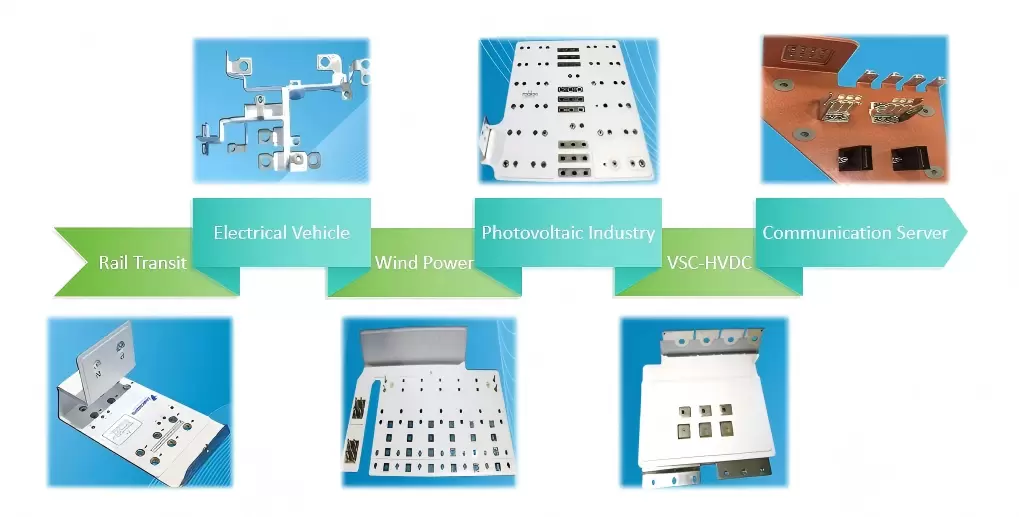
HVDC Transmission Systems: Laminated bus bars carry high DC currents efficiently while minimizing losses over long distances.
Renewable Energy Integration: Solar farms and offshore wind substations benefit from reduced resistive losses and enhanced reliability.
Industrial Automation: High-current DC drives and motor control centers require stable voltage and minimal EMI, achieved with laminated bus bars.
Power Electronic Converters: Laminated designs improve thermal management and extend the life of converters in smart grids and energy storage systems.
VI. Implementation Best Practices
Layer Thickness Optimization: Choose the number and thickness of copper laminations to balance current-carrying capacity and mechanical strength.
High-Temperature Insulation: Use dielectric films rated for maximum expected temperatures to prevent breakdown under load.
Proper Cooling Channels: Integrate bus bars with airflow or liquid cooling where high current densities are expected.
Periodic Inspection: Check for delamination, oxidation, or thermal degradation to maintain long-term reliability.
By following these guidelines, engineers can maximize the performance and lifespan of laminated copper bus bars in critical HVDC systems.
VII. FAQs – Laminated Copper Bus Bars
Q1: Why are laminated copper bus bars more efficient than solid ones?
A1: Lamination reduces skin and proximity effects, distributes current evenly, and lowers resistive losses, improving overall efficiency.
Q2: Can laminated bus bars handle high-current HVDC applications?
A2: Yes. Laminated copper bus bars are specifically designed for high-voltage, high-current environments, with superior thermal management.
Q3: How does lamination reduce EMI?
A3: The multilayer structure confines magnetic fields, reducing electromagnetic interference in nearby circuits.
Q4: Are laminated bus bars suitable for renewable energy systems?
A4: Absolutely. They improve energy transmission efficiency and reliability in solar, wind, and hybrid renewable grids.
Q5: What maintenance is required for laminated bus bars?
A5: Periodic inspection for layer integrity, oxidation, and thermal degradation ensures consistent performance.
Conclusion
Laminated copper bus bars are a transformative solution for high-voltage DC transmission systems, offering reduced resistive losses, enhanced thermal management, and superior electromagnetic performance. Sun.King Technology leverages advanced lamination techniques, premium copper, and high-temperature insulation to deliver bus bars that meet the rigorous demands of HVDC grids, renewable energy integration, and industrial automation. By adopting laminated designs, engineers and system integrators can achieve higher efficiency, reduced operational costs, and reliable long-term performance in next-generation power transmission applications.