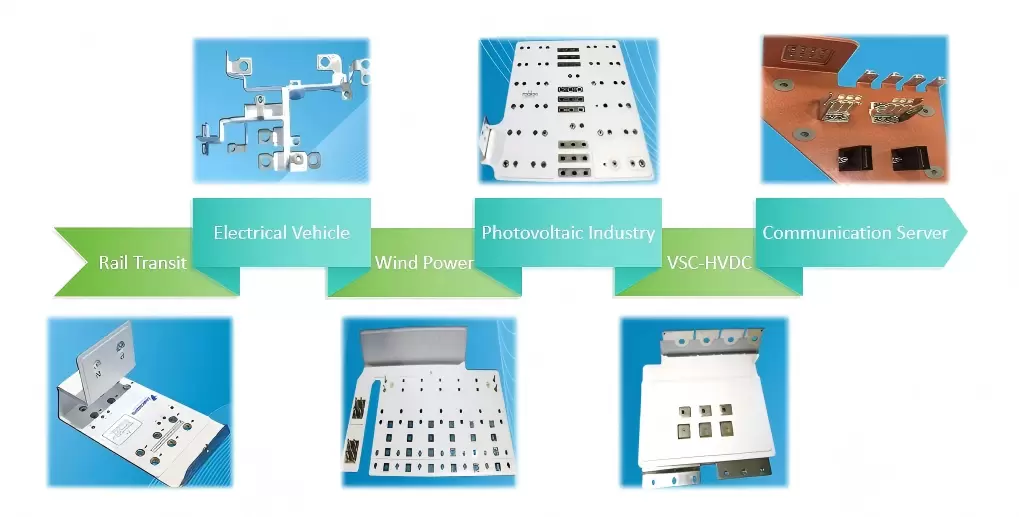
In modern power electronics, inductive impedance is no longer a secondary consideration—it is a defining factor that affects efficiency, electromagnetic compatibility (EMC), thermal performance, and overall system reliability. For high power modules used in renewable energy, HVDC, electric vehicles, rail transit, and industrial automation, a high inductive impedance connection can create voltage overshoot, reduce switching efficiency, and trigger EMI problems. That is why Sun.King’s bending laminated bus bar solutions are increasingly preferred in high-power applications where the electrical path must be optimized for both performance and reliability.
Sun.King Technology Group Co., Ltd. is a technology-leading supplier of power electronic devices and system integration solutions. Founded in 2002 and listed on the Hong Kong Main Board in 2010, Sun.King has expanded into a global enterprise with R&D centers in China and Europe, more than 260 patents, and broad application coverage in renewable energy, smart grids, EVs, and industrial automation. The company’s laminated busbar products, especially in bending configurations, are designed to meet the complex installation requirements of high power modules while delivering low inductive impedance, high interference immunity, and repeatable electrical performance.
1. Why Inductive Impedance Is a Core Limitation in High Power Modules
Inductive impedance is directly related to the magnetic field generated by current flow. In high power modules, rapid switching events can create transient voltage spikes proportional to the inductance and the rate of current change (di/dt). This can lead to:
Voltage overshoot at switch nodes
Increased switching losses
EMI emissions that require additional filtering
Thermal stress due to repeated transients
Reduced system reliability and lifespan
For high-power applications such as HVDC transmission, smart grid converters, and EV inverters, managing inductive impedance is a critical design goal. Laminated busbar technology addresses this by minimizing loop area and optimizing conductor geometry.
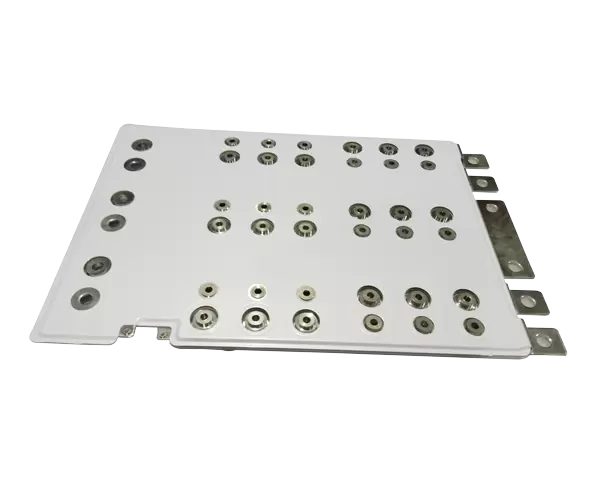
2. How Bending Laminated Bus Bar Reduces Inductance (and Why It Matters)
A laminated busbar consists of multi-layered conductive sheets separated by insulating materials. The configuration reduces loop inductance by enabling closely coupled current paths and minimizing magnetic flux. When the busbar is bent to fit complex module layouts, the design still maintains low inductive impedance through:
Tight layer stacking that maintains close proximity between positive and negative current paths
Controlled bending radius that prevents deformation-induced gaps
Symmetrical current distribution across layers
Reduced loop area even in complex geometries
Compared with traditional wiring or bar-based connections, a bending laminated busbar achieves lower inductive impedance because it controls the current path and keeps the magnetic field self-canceling within the structure. This is essential for high-power modules where switching speeds are high and system stability is non-negotiable.
3. The Engineering Advantage of Bending for Real-World Module Layouts
High power modules often have complex installation requirements. Space constraints, cooling paths, and mechanical mounting demands can make straight busbar designs impractical. Sun.King’s bending laminated busbar solutions provide:
Customizable shapes to fit module housings
Optimized routing to reduce stray inductance
Improved mechanical stability compared to loose wiring
Cleaner thermal paths for cooling systems
Because Sun.King is a full system integrator with extensive R&D and manufacturing capacity, their laminated busbar solutions are not only technically advanced but also practical for mass production and reliable deployment in global markets.
4. Repeatable Electrical Performance: Why Consistency Matters in High Power Systems
In high power applications, repeatable performance is critical. A busbar that performs well in prototype testing but varies in production can lead to:
Sun.King’s laminated busbar technology provides repeatable electrical characteristics due to standardized manufacturing and tight quality control. This is especially important in industries like renewable energy and EVs where system downtime has significant cost implications.
5. High Interference Immunity: A Necessity for Next-Gen Power Electronics
As power electronics become more compact and operate at higher switching frequencies, EMI becomes a major challenge. Inductive impedance contributes to EMI through:
By lowering inductive impedance, Sun.King’s bending laminated busbar solutions inherently reduce EMI generation. This improves system stability and reduces the need for additional filtering components, which can increase cost, weight, and space.
Industry reports indicate that EMI compliance is a major driver in power electronics design, and busbar technology is a key lever in meeting EMC standards while maintaining high power density.
6. Thermal and Reliability Benefits: The Secondary Gains of Low Inductance
Lower inductive impedance not only improves electrical performance but also contributes to better thermal behavior:
Reduced switching losses lead to lower heat generation
Stable current paths reduce hot spots
Higher interference immunity reduces failure risk
For high power modules, reliability is often more valuable than marginal performance gains. Sun.King’s laminated busbar products help ensure stable operation under continuous high current load, aligning with the company’s mission of supporting green energy development through technological innovation.
7. FAQ: Bending Laminated Bus Bar for High Power Modules
Q1: What is the main advantage of laminated busbar vs. traditional wiring?
Laminated busbar reduces inductive impedance and improves EMI performance while providing mechanical stability and repeatable electrical performance.
Q2: Why is bending important in busbar design?
Bending allows busbars to fit complex module layouts while maintaining low inductance and controlled current paths.
Q3: Can laminated busbars handle high current densities?
Yes. Laminated busbars are designed for high current applications and can be engineered for thermal management and reliability.
Conclusion: Low Inductance, High Reliability, and Real-World Fit
For high power modules, inductive impedance is a key performance constraint. Sun.King’s bending laminated bus bar solutions address this by providing multi-layer, closely coupled current paths that minimize inductance while allowing complex installation geometry. Supported by Sun.King’s global R&D network, advanced manufacturing, and strong innovation track record, these busbar solutions deliver repeatable electrical performance, high interference immunity, and improved reliability—making them an ideal choice for next-generation power electronics in renewable energy, EVs, smart grids, and industrial automation.